
Skip to content
PHARMACEUTICAL

Pharmaceutical security and business continuity

GSK and leading pharmaceutical companies use the Human Risks security and resilience platform to manage physical security risk and business continuity across every site and operation.
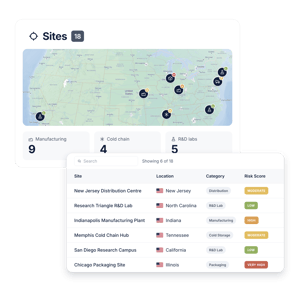
Human Risks for Pharmaceuticals – Sites Management View

One platform for every site

Physical security and business continuity teams in the pharmaceutical industry protect manufacturing and research sites, often under several regulators at once. Human Risks brings pharmaceutical security risk management, business continuity and compliance evidence into one platform, with the same method applied at every site. Today the platform supports security programmes at more than 7,500 sites worldwide.

What's at stake


50%

of responses from chemicals, pharmaceutical and biopharma companies name business interruption as a top risk, second only to cyber incidents (Allianz Risk Barometer 2026) 


1 in 10

medical products in low- and middle-income countries is substandard or falsified (World Health Organization)


About 60%

of US intravenous solutions came from one plant, which Hurricane Helene flooded in 2024 (Healthcare Dive)

Physical security protects products from plant to patient, and business continuity keeps supply moving when a site goes down.

Top 3 security challenges for the pharmaceutical industry

01
One site, several rulebooks

A single site can fall under Good Manufacturing Practice (GMP) inspections, the Critical Entities Resilience (CER) Directive and the NIS2 Directive at once. Each sets its own expectations for physical security and business continuity. GMP alone requires manufacturers to take steps to prevent the entry of unauthorised people (PIC/S GMP Guide, Chapter 3). When that evidence sits in spreadsheets at each site, every inspection means chasing people and documents, and gaps between sites surface only when an inspector finds them. 

02
Customers audit every site

Under EU GMP Chapter 7, pharmaceutical companies must assess any contract manufacturer before outsourcing and keep the right to audit it (EudraLex). Those audits cover GMP rules such as keeping unauthorised people out of production and storage areas. A manufacturer that cannot show how each site controls access puts that approval at risk. 

03
Disruption at one plant reaches patients

Concentrated production means a flood or fire at one plant can become a national shortage, as Hurricane Helene showed. The CER Directive expects designated entities to keep continuity and recovery plans and to have continuity and recovery measures in place. Plans kept as static documents are hard to test, and harder to activate when the site that wrote them is offline. 

How Human Risks helps

CHALLENGE

Each site answers to GMP, CER and NIS2, with evidence scattered across spreadsheets at every site

HOW HUMAN RISKS SOLVES IT

Risk assessments, incident reports and business continuity plans for every site sit in one platform, built on one method. Asset types, threats and treatments are set once, in line with company policy, and applied to every plant and warehouse.

CHALLENGE

Every customer audit checks how each site keeps unauthorised people out

HOW HUMAN RISKS SOLVES IT

Structured risk assessments record how each site controls access, with every mitigation measure tracked to completion.

CHALLENGE

A flood or fire at one plant can become a shortage that reaches patients

HOW HUMAN RISKS SOLVES IT

Business impact analysis identifies the plants and products patients depend on most, business continuity plans are ready to activate, and crisis management and mass communications coordinate the response when a site goes down.

See it with your own sites

Regulations and standards for the pharmaceutical industry
Human Risks CER Compliance
TOUCH
Critical Entities Resilience Directive (CER)

The CER Directive is EU law on the resilience of essential services. Pharmaceutical manufacturers and holders of a distribution authorisation can be designated critical entities, which must assess risks including supply chain dependencies, put security measures in place, plan for continuity and recovery, and report incidents. Human Risks supports these steps with risk assessments, business impact analysis and business continuity plans. Read more in our CER Directive Practical Guide.

Human Risks GMP Compliance
TOUCH
EU Guidelines for Good Manufacturing Practice (GMP)

Chapter 3, point 3.5, expects manufacturers to take steps to prevent the entry of unauthorised people into their premises. Human Risks records site risk assessments, incidents and follow-up tasks as inspection evidence.
Human Risks NIS2 Compliance
TOUCH
Directive on a high common level of cybersecurity across the Union (NIS2)

The NIS2 Directive covers manufacturers of pharmaceutical products and entities carrying out medicinal research and development. It requires measures covering all hazards, protecting information systems and their physical environment from theft, fire, flood and unauthorised physical access, and including business continuity and crisis management. Human Risks covers the physical security and business continuity side of that requirement.
Human Risks DEA Compliance
TOUCH
DEA security requirements for controlled substances (21 CFR 1301.71)

US Drug Enforcement Administration (DEA) rules require every registrant handling controlled substances to provide effective controls against theft and diversion. When judging a site, the DEA weighs factors such as its location, alarm systems, key control, employee supervision and visitor procedures.

Crane Currency and Human Risks

Crane Currency answers to central bank auditors much as pharmaceutical sites answer to medicines inspectors, and with Human Risks it cut audit preparation for its ISO 14298 certified sites from days to hours.
Crane Currency Case Study - Graphic

Why Human Risks?

1
Built for Adoption.
Generate baseline assessments in minutes and assets in one click with tools built for end users rather than experts. Seamless adoption makes resilience part of your organizational culture.
2
Guided by Experts.
Methodologies refined through partnerships with global Fortune 500 organisations and 2,500+ professionals. Expert guidance gets you to value in weeks, and our 96% retention rate proves it.
3
Unified for Resilience.
Manage risk, compliance, and business continuity in one platform. AI-powered automation generates Risk Assessments and Impact Analysis in 15 minutes with 90% less manual work. ISO, NIS2, CER compliant.

See a security risk assessment
completed in 15 minutes

A live demo of Human Risks, built around your sites, threats and continuity plans.

Trusted by GSK, HSBC and IKEA · ISO 27001 certified

Frequently asked questions

What does pharmaceutical security cover? Pharmaceutical security protects the people, sites, research and products of a pharmaceutical company from theft, diversion, falsification and disruption. It covers manufacturing plants, research sites and warehouses, alongside business continuity planning for when a site goes down.
Does Human Risks support CER Directive compliance for pharmaceutical companies? Yes. The CER Directive asks designated critical entities to assess risks, put security measures in place, plan for continuity and report incidents. Human Risks covers these steps with risk assessments, business impact analysis, business continuity plans, crisis management and incident reporting. Our CER Directive Practical Guide explains the requirements in detail.
Can Human Risks assess every site the same way? Yes. One risk assessment method applies to every plant, warehouse and research site, with the results kept in one system. Teams predefine asset types, threats and treatments in line with company policy and match them to site categories.
What security measures do the EU GMP guidelines require? Chapter 3 of the EU Good Manufacturing Practice guidelines expects manufacturers to take steps to prevent the entry of unauthorised people. Production, storage and quality control areas should also not be used as a through route by staff who do not work in them. Human Risks lets teams assess each site against these measures and keep the results as inspection evidence.
How long does implementation take? Human Risks customers see results within weeks, with expert guidance through onboarding. Support continues after launch, and 96% of customers stay with us long term.

Free resources